31 Jul 2014

Misread by People

Minimalism as Less Elements

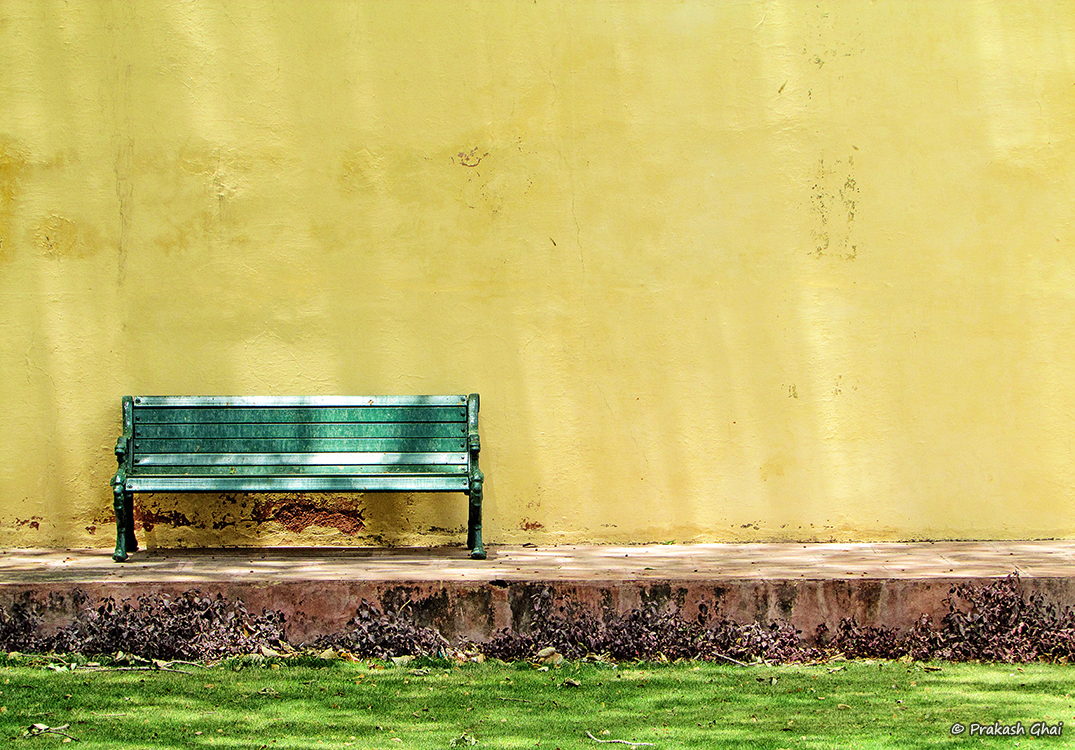
Green bench against a yellow wall at Jantar Mantar Jaipur, minimalist photography by Prakash Ghai
Minimalist Photography by © Prakash Ghai


Minimalist Photography using a Green bench against a yellow wall at Jantar Mantar Jaipur.


"Sometimes you feel that you've been "Misread" by a lot of people and you need some time on your own alone in the park, sitting on the bench reflecting back on life."

In this minimalist composition I have applied rule of thirds twice. Once at the bottom and one on the left.

Therefore, there is plenty of negative space both above the bench and also to the right, to add that classic subject isolation minimalist feel.

A green bench against a large yellow wall is an Ideal setting. To begin with, what made me attracted towards the bench, was the subtle light and shadow differential on the wall.

It was just too beautiful to look at. Maybe you could also find this, if you visit Jantar Mantar, Jaipur. 

What Makes This Minimalist Photography Composition Work?


This shot falls under the Less Elements type of minimalist photography. One isolated subject and negative space.

If you are learning minimalist photography, this composition is worth studying. The rule of thirds is something most photographers apply once.

Applying it twice in the same frame, on two different axes, is what creates that corner anchor effect. The bench is not centered. It is not floating. It sits exactly where the eye expects weight to be, and then the rest of the frame opens up.

The color contrast here is also doing a lot. Green and yellow are analogous colors, close on the color wheel, so they do not fight each other. The wall does not overpower the bench. The bench does not disappear into the wall. That balance is what makes the image calm rather than chaotic.

Also Check:

5 Minimalist Photos that Depict Less is More that showcases the use of isolated subjects and negative space.


Jantar Mantar Jaipur for Minimalist Photography


Jantar Mantar in Jaipur is one of the best locations in the city for minimalist photography. Wide walls, clean geometry, and good directional light for most of the day.

If you are visiting Jaipur and want to practice minimalism, add it to your list.

Want to own this Minimalist Photo as a Print?

A fine art print of Misread is available on Fine Art America, printed on archival quality paper and shipped worldwide. Buy the print here.

Unsuccessful Camouflage

Minimalism as in Small Objects

A Black and White Minimalist Photo of a Bird trying to hide behind on a street light.
Minimalist Photography by © Prakash Ghai
Buy Now


A black and white Minimalist Photo of a small bird trying to hide behind a street light.


The Bird looks as if it was trying hide behind the light by Camouflaging.
This is Minimalism as in Small objects. As you can see here the size of the bird is extremely small and that is the primary subject. To achieve the small size, a simple way is, not to get too close to the subject and shoot from a distance.

The white background you see is the clear blue sky which I have de-saturated via photo editing. To add a bit of spice to the image I turned the camera in my hand to so that the street lamp tilted a little to the left and that added a sense of movement to the image. 

30 Jul 2014

Dual Staircases

Minimalism as Simple Geometry

Dual staircase openings on a building facade, black and white minimalist architecture photography by Prakash Ghai
Minimalist Photography by © Prakash Ghai
Buy a Print

A Black and White Minimalist Architecture Photograph of a Dual staircase.


Why I Paired Two Staircases Instead of One?


I was walking around Swej Farm in Jaipur and I saw these two staircase openings cut into the side of a building and I just stopped there for a minute because something about the way they were sitting on that plain wall felt like it was a decent frame to capture, I just had to figure out exactly what that frame was.

The staircases were quite far from me, maybe 50 to 60 feet away, so I pulled out my Canon 55-250 mm lens and zoomed in a lot to get close to what I was seeing with my eyes, and because I was zoomed in that much I had to shoot at a higher shutter speed to make sure the image did not come out blurry, which is always the risk when you are handholding at long focal lengths.

I mostly never carry a tripod because I find it very inconvenient to set up on public places as I am an introvert. Instead I always shoot RAW and JPEG together so that later I can open the RAW file for corrections when at home and pull out more details or add some sharpness to the photograph to compensate for the handheld blur.

My first attempt was just capturing one staircase, shot in landscape orientation. When I reviewed it on the camera LCD screen, it felt a bit flat and boring. The photograph was not saying anything, rather just showing a shape sitting there with no real reason. That is the thing about minimalist photography and black and white minimalism specifically, you can have a clean frame and good light and still have a photograph that has no life in it if the composition is not doing any work.

The One Decision That Changed This Minimalist Shot


So I stepped back a little and looked at the full wall again. I realised that having both the  staircases together in a portrait frame was the right shot. When you stack them one above the other, the eye starts moving between them and comparing them and finding the small differences. That is what gives the photograph its energy.

In black and white minimalism the tonal contrast is doing a lot of the heavy lifting, so the dark underside of each staircase sitting against the lighter wall is where the whole image is held together. Portrait orientation was the right call.

Swej Farm is not a famous location and most people walk past buildings like this without a second look, but that is where I find the photographs that interest me the most. 

In the ordinary places where real geometry hides. The architecture minimalism is just sitting quietly waiting for someone to slow down, notice it and frame it right. That is what minimalist photography is about, the art of noticing both what's hidden and goes unnoticed despite being there.

Black and White Minimalism

Minimalism Type: Less Elements

Black and White Minimalist Photography of a Torn cloth hanging over an old wooden thatch roof, shot in Jaipur by Prakash Ghai
Black and White Minimalist Photography by © Prakash Ghai
Buy Now

Black and White Minimalist Photography using Less Elements and Negative Space to amplify the attention on the subject.


To compose, I placed the subject on the right, where I have primarily  interpreted the subject as intersecting lines. The torn hanging cloth adds to a bit of a story or lets say art effect to the image. To Edit this and make it look this way, one needs to simply slide up both the contrast and the brightness slider. The contrast slider a lot more, that makes the background almost disappear and makes the subject stand out. Note: don't overdo it but. 

The Setting Sun

Minimalism Type: Zeroism

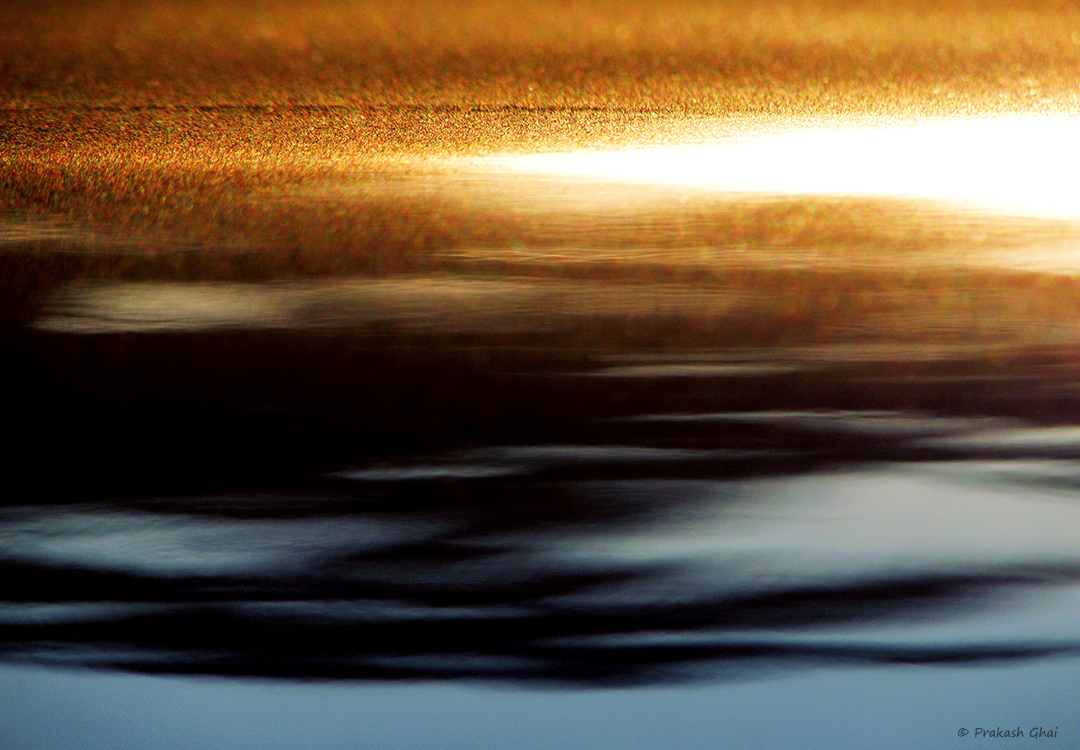
Abstract sunset light reflecting off a car roof with golden orange glow and dark rippling tones, Zeroism minimalist photography by Prakash Ghai, Jaipur
Minimalist Photography by © Prakash Ghai

An Abstract Minimalist Zerosim Photograph comprising of the Rays of the setting sun on the roof of a car.


I was standing outside the front gate of my house in late evening with about 20 minutes of sunlight left. When I noticed what the setting sun was doing to the roof of the car parked right in front of me, I zoomed in with my camera and spotted this beautiful serene view, where everything was in harmony and yet it appeared unrecognisable. I knew it later that it was something the light coming from the setting sun created.

What are you actually looking at?


The golden orange light you see at the top is the reflection of the setting sun. The dark tones below it are shadows of a tree in front of me. The rest of the blue tint you see is the roof of the white car appearing bluish due to the fast dimming evening light. 

It is simply a car's roof two feet away from where I was standing and you would never known that at first glance and that is exactly what makes photograph fall under the Zeroism category of minimalist photography.

Why this is Zeroism?


The subject does not introduce itself and the composition has a clear minimalist structure. The golden upper half, the dark lower half, and the light cutting through the centre. That structure is what separates Zeroism from pure abstract photography. The logic is there underneath and the elements are minimal.

How I read this photograph


The gold is almost aggressive. The dark area below is heavy and the light in the centre sits between the two, holding everything together without resolving anything. It feels like a moment caught between burning out and going quiet. Most people go through this.

How this Minimalist Photograph was made and edited?


This took me about ten minutes to edit in photoshop. I increased the vibrancy and saturation slightly and added a touch of sharpness. The rest was already there in the frame. Such subjects either reveal themselves to you or they don't. Spotting them comes only with practice and developing a vision for the 8 types of minimalism.

Frequently Asked Questions about Zeroism


Q. Can Zeroism be shot anywhere or do you need a specific location to capture it?
A. Anywhere. This was shot outside my front gate. Zeroism is about observation, not location.

Q. How do I know if my abstract photograph qualifies as Zeroism?
A. If you can explain the composition using minimalist principles but the subject still does not reveal itself at first glance, and to a relatable real world object or subject, then it is Zeroism. If there is no compositional logic at all then it is pure abstract.

Q. How much editing is acceptable in Zeroism?
A. Minimal editing is preferred. Adjusting vibrancy, saturation, and sharpness to bring out what was already there is fine. Heavy manipulation that creates the subject rather than reveals it moves away from the intent of Zeroism.

Q. Do I need to plan Zeroism shots in advance?
A. No. Most Zeroism photographs are not planned. You spot something and you shoot before it is gone. The only thing you can train is your eye to spot them faster.

Isn't it rather ironic that on that evening the light lasted only about twenty minutes and the photograph took roughly ten seconds. But two years of looking is what made the shot possible.

Also please don't confuse yourself with the URL of the post which says this is low detail minimalism, I myself first thought this was a Low Detail shot and not Zeroism. This is confusing for sure. 

Must Read:

    28 Jul 2014

    Phases of Life and Photography: & where "Minimalism" fits in.

    We all pass through three phases in life, each shaping our art. Align your photography with your current phase, and your work transforms reflecting your mind’s true state.

    Phase   I: Accumulation

    Phase  II: Moderation

    Phase: III: Shedding

    Phase I: Accumulation


    By accumulation I mean the race for material gratification in objects like cars, bikes, mobiles, gadgets, jewellery, luxurious houses, vacations etc and money in general. In this phase one wants to accumulate as much as he/she can or all of what is possibly available.

    This is a good phase to explore street photography: crowded frames, layered textures, competing subjects.

    The chaos in the frame mirrors the restlessness inside. In accumulation, nothing feels insignificant and everything demands attention, and that energy translates naturally into busy, dense compositions. This is an ideal form for people who identify themselves in this phase.

    Please See: Be it Photography or be it Art, it is all but a reflection of the photographer's/ artist's mind and what is he/she is currently experiencing in life and the phase he/she is passing through.  
     

    Street photography of a trader at Pushkar Ajmer Rajasthan by Prakash Ghai
    Street Photography by © Prakash Ghai


    Phase II: Moderation


    In the phase of Moderation, a quiet realization settles in that what you have is enough. The daily struggle has eased, life has found its rhythm, and contentment replaces the constant chase.

    This phase calls for contemplative landscape photography. You are no longer rushing through life, you are watching it. The world has slowed down enough for you to notice its quieter beauty. Still waters, long shadows, solitary trees. You are present and unhurried, and that stillness translates naturally into landscapes that breathe. You are no longer chasing the frame, you are waiting for it.


    A row of multi-story buildings along a lakefront in an Indian city, with their colorful facades perfectly reflected in the calm water below, set against a hazy blue sky and distant hills, shot by Prakash Ghai
    Contemplative Landscape Photo By © Prakash Ghai
    Buy a Print

    Phase III: Shedding


    It is only when you have reached Phase III is when you realize that you need to do away with all the Extra stuff that you have. This is where Minimalism could seep in.

    Your understanding towards the benefits of "less" increases by the day and it starts reflecting in your personality. It is now that you really understand the importance of simplicity over luxury. The new luxury for you now is Convenience which is a by-product of simplicity. You also now have more time for yourself and have most of the answers of life that you have been looking for all your life.

    This is a good time to look at doing Minimalist Photography as now your mind is almost like an empty slate with only the necessary data to hold. When such a mind depicts itself via Minimalist Photography, the results are usually fantastic.

    Black and white minimalist photography of a sea dock curve with still water negative space by Prakash Ghai
    Minimalist Photography © Prakash Ghai 

    The three phases are not a hierarchy. None is better than the other. Each produces honest, powerful photography when you shoot from where you actually are.

    The only question worth asking is: which phase am I in right now, and is my photography reflecting that honestly?

    That alignment between your inner state and your frame is what makes the difference.​​​​​​​​​​​​​​​​

    Prakash Ghai

    More Articles on Minimalist Photography

    Right angled Triangle Vs the Square

    Minimalist Photography as Simple Geometry 


    Square window with diagonal shadow creating light and dark contrast on white wall at Jawahar Kala Kendra Jaipur, minimalist black and white photography by Prakash Ghai
    Black and White Minimalist Photography by © Prakash Ghai
    Jawahar Kala Kendra, Jaipur Buy Now

    A Black and White Minimalist Photograph of a Right angled Triangle and a Square at Jawahar Kala Kendra, Jaipur


    I have used light and shadow here to highlight the geometry in the frame. The core of the photograph involves two simple geometric shapes.

    a) Square and 
    b) Triangle. 

    Also, if you observe closely, there is another square being formed within the primary square, because of the light and shadow game-play. The shadow triangle on the bottom left acts as the supporting actor like in films, for the main lead i.e the Square.

    Keeping the photo to monochrome is always preferable when shooting Minimalist Photography as Simple Geometry as all the shapes and lines get accentuated. The visual impact as a result is better.


    Other Minimalist Photos that also contain a Square:


    Circle Square Waves


    Lines Vs Square


    White Square


    10 Squares

    Types Of Minimalism

    Most photography guides talk about minimalism as if it  is just one style. But in reality, it isn’t.

    Through observation and practice, I’ve come to see 8 different types of minimalism in photography. Each one works in its own way, with a different visual logic, shooting approach, and emotional impact on the viewer.

    Knowing which type you’re naturally drawn to can make it much easier to shape your own minimalist photography style.

    If you are new to this, start by understanding what minimalist photography is and what makes it different from other styles. Once you have that foundation, the 8 types below will make a lot more sense.

    Last Updated: May 2026

    There are 8 Types of Minimalism in Minimalist Photography 


    I will take each one of these sub-types one by one and lay down my interpretations of the same. I will also include photo examples for each Type of Minimalism for better comprehension.

    1) Minimalism as Less Elements


    Explanation: Here one isolated singular subject can be used as the primary subject, so that it receives 100% percent attention span. A secondary supporting subject can also be used to enhance the composition.

    But it should be made sure that if not 100% at least the majority of the attention of the viewer remains with the primary subject.

    Example:


    alt="Minimalist photography example of red pipe with negative space on wall shot by Prakash Ghai in Jaipur
    Minimalist Photography by © Prakash Ghai
    Minimalism as Less Elements Buy a Print

    As you can see above, I have used a primary subject i.e the Red Pipe and a supporting subject or the Gray Pipe, which shares less attention, as it is of the same color as the wall.

    The number of elements in this Minimalist Photograph are limited to two and focus on them has been enhanced or redirected by using a lot of empty or Negative Space.

    2) Minimalism as Few Distinctive Colors


    Explanation: You can also use a mix of Few Contrasting Colors, primarily forming some shapes, patterns or lines as core in a Minimalist Photograph. Ideally, keep at least two to three colors in the palette, if not more.

    At the same time you must try to restrict the overall elements in the frame and keep it simple. Plus, it should be obvious that the photographer's intent is clearly to show few distinctive colors as the type of minimalism.

    Example:

    Minimalist photography example of a blue navy and orange colorful wall by Prakash Ghai Jaipur
    Minimalist Photography By © Prakash Ghai
    Minimalism as Few Distinctive Colors

    👗 Love the color palette of the photo above?

    Download it and use the Wear My Aesthetic tool to generate a minimalist outfit inspired by its colors.

    3) Minimalism as in Small Objects 


    Explanation: This form of Minimal is literal in nature, where the subject shown is very small it Minimal in size, in comparison to the overall elements within the frame. Like how I've shown a small pigeon walking on a terrace railing below. Such Minimalist Photographs remind us of how minuscule our existence is in this infinite universe.

    Example:


    Minimalist photography example of a bird walking on a terrace railing by Prakash Ghai
    Minimalist Photography by © Prakash Ghai
    Minimalism as in Small Objects Buy a Print
     

    4) Minimalism as Simple Geometry


    Explanation:  Use of Simple Geometric Shapes such as circles, lines, curves, squares, cylinder, rectangles, triangles etc are some of the Basic Geometric Shapes one can use in such Minimalist Photographs. One does not need to use all of these shapes within a Single Photograph.

    You can use one or more or maybe even many of these, till the time you keep the Photograph as decluttered as possible.

    Example:

    Minimalist photography example with Simple geometric square shapes on a yellow wall
    Minimalist Photography by © Prakash Ghai
    Minimalism as Simple Geometry View NFT

    Like in the above example, I have used only Squares, one of the light squares changed its shape due to the angle of light and looks like a rhombus. A diagonal line is cutting the primary square. So, you can see multiple simple geometric elements, yet the frame is kept simple.

    5) Minimalism as Parts of the Whole


    Explanation: In such kind of Minimalist Photographs, a lot is left to the Imagination of the viewer. Here, we only show a part or a snippet of the main subject to the viewer and make him imagine the whole/rest of it.

    This creates a sense of mystery about the subject and therefore, this is a great way to make the viewer engage and connect with the Minimalist Photograph. I have only shown a part of the chairs with a clean minimalist background and negative space in the example shown below.

    Example:

    Minimalist Photography example using parts of two chairs against red background by Prakash Ghai
    Minimalist Photography by © Prakash Ghai
    Minimalism as Parts of the Whole

    6) Minimalism as in Repeating Shapes


    Explanation: Images comprising of symmetrical repetition of mainly basic geometrical shapes (ideally) fall under this category of Minimalist Photography.

    The reason repetition works in minimalism is straight forward. The brain processes repeating identical shapes as one unit. One window is one unit. Four identical windows is still one unit to interpret. That cognitive ease is the reason this type works as minimalism. 

    Let's take an example to better understand this.

    Example:

    Minimalist Photography example using windows in repetition
    Minimalist Photography by © Prakash Ghai
    Minimalism as in Repeating Shapes View NFT

    In the above Photograph, you can see 4 windows in repetition on a wall. These windows have perfect basic geometric shape (rectangles) and they are in symmetric order. Collectively they are one unit as well as standalone. 

    One of the windows doesn't have glasses and thats why I captured it as it makes the composition interesting.

    If the photo is too busy you can also call it Maximally Minimal sometimes, but mind you there should not be any clutter and the photo must have tremendous visual clarity and easy comprehension as discussed above.

    The above photograph could have had 16 windows in repetition and yet still be minimal, provided it had  tremendous visual clarity and easy comprehension.

    7) Minimalism as Low Detail


    Explanation: Such Minimalist Photos generally carry very Low Detail. Most of the details are intentionally left out. This lack of detail engages the viewer quite well and are generally thought provoking. These images are not abstract in nature, one can still relate the subject depicted to real life/world. 

    Below you see a low detail minimalist photograph of a palm leaf leaning against a fabric.

    Example:

    Minimalist Photography Example of low detail minimalism explained, a black and white photo of a palm leaf leaning against tent cloth by Prakash Ghai
    Minimalist Photography by © Prakash Ghai
    Minimalism as Low Detail

    8) Zeroism


    Explanation: In such minimalist photographs the subject is not directly pointed at. The viewer is intentionally made to guess what the actual subject might be. Your eye keeps searching for the core subject.

    The name Zeroism comes from a simple idea. You start at zero when you look at the image. Zero subject recognition. The elements may not be clearly identifiable always or be relatable to any real world object. But the composition still has compositional logic and  elements of minimalism required for minimalist photography.

    The subject simply refuses to introduce itself. We can also call it Abstract Minimalism.
    But Zeroism or Abstract Minimalism is not abstract photography. Abstract photography works purely through feeling, color, texture, or form with no compositional discipline underneath. In Zeroism, a minimalist structure is always present.

    Example:


    Minimalist Photography Example of Zeroism shown via blurred abstract shapes behind a plastic curtain in monochrome
    Minimalist Photography by © Prakash Ghai
    Zeroism Buy a Print

    source: https://sites.google.com/site/minimalismgroup/define

    As you can see in the above photo of the black and white hazy arrangement has order and compositional logic but its not clearly identifiable. The elements are less and minimal,  also the photograph is not confusing. It is easy on the mind. If I don't tell you, you may not be able to guess the real world subject. The subject that I chose was  colorful boxes illuminate with light at a stationery store, as seen through a scratchy plastic curtain in focus at low aperture.

    Conclusion


    I hope the above examples of Minimalist Photographs help in explaining each Type of Minimalism in Photography. 

    These 8 types are not rules. They are a vocabulary. Once you know the words, you stop wandering in front of a subject hoping something clicks. You show up with a question instead. Which type of minimalism am I looking for here?

    How to Identify Your Dominant Minimalist Photography Type?


    If you are just starting out, pick one type of minimalism from the list above and shoot only that type for a few weeks. Less Elements is a good starting point for most beginners.

    If you have been shooting for a while, go back and look at your last 50 photographs. You will notice a pattern.

    Most minimalist photographers keep returning to one or two types of minimalism without realising it. Someone who keeps framing lone objects against plain walls is shooting Less Elements without knowing it. Someone obsessed with windows and grids is already working in Repeating Shapes.

    "The minimalist photography type you return to most without thinking is your dominant type."

    Once you know it, you stop shooting minimalism by accident and start shooting it with purpose and intent. The other 7 types of minimalism become deliberate choices you can move into when you are ready.

    Personally, Simple Geometry is the type I keep coming back to the most, out of all 8 types. Sharing another Simple Geometry Minimalist Photograph below: It's more of looking up or look-up architectural minimalism. Find a couple more Simple Geometry minimal shots in my portfolio.

    Two red-framed square windows on a white wall with a diagonal light line along the edge, minimalist architectural photography, Jaipur, shot by Prakash Ghai
    Minimalist Photography by © Prakash Ghai

    Types of Minimalism FAQs


    Q. Can one photograph belong to more than one type of minimalism?
    A. Yes, the types can overlap. The type that has the most impact visually and is evident, is the right type for that photograph.

    Q. Which type of minimalism is hardest to master?
    A. Zeroism, because there is no obvious subject to anchor the frame. 

    Q. Which type of minimalism is best for beginners?
    A. Less Elements. Start with one clear subject and empty space around it.

    Q. Can I find minimalism in busy locations or do I need to go to a quiet, less crowded space?
    A. You can do either, but ideally you can find minimalist frames anywhere. In busy spaces for example, you can switch to look-up minimalism or wall close-ups. 

    Q. Can I do minimalism using landscape and people?
    A. Sure, landscape minimalism is fairly common, people minimalism requires decent practice. You can find one people minimalist photo example on the Contact Me page. But, most core minimalist photographers generally prefer shooting objects.

    Q. How to remember all 8 types of minimalism while on field with my camera?
    A. Write all 8 types of minimalism on a cue card, visiting card size. Take it out of your pocket when in front of a subject and decide the category. Eventually, you won't need the card.

    Before you start capturing your first few Minimalist Photographs, I would strongly suggest you to read my post What is Minimalist Photography? and my other post Train your Eyes for Minimalist Photography.


    A little about me


    I am a minimalist photographer based in Jaipur, India, with 14 plus years of practice focused entirely on minimalist photography: light, shadow, geometry, and negative space.

    I founded the #LearnMinimalism movement n Instagram, which has curated over 707,000 images globally.

    My work has been licensed to Nike, featured in The Economic Times and China Daily, and collected by a former Sotheby’s curator on Tezos. Collect my NFTs →

    You can read more about me or see my media coverage if you want to know more.


    See these Types as Fine Art Prints


    Every type of minimalism described in this guide exists as a real minimalist photograph in my collection. Less Elements, Simple Geometry, Repeating Shapes, Zeroism. I have shot them all, mostly in Jaipur, over a decade of practice.

    If something in this guide clicked for you, there is a good chance one of these prints will look exactly right on your wall.

    Browse the collection on FineArtAmerica. Photos ships worldwide, printed on archival quality paper and canvas:
     
    If this guide was useful, a small coffee goes a long way.

    Experience Minimalist Photography in Person at Jawahar Kala Kendra, Jaipur


    Shadow of a water outlet falling diagonally across a deep red textured wall beside the silhouette of an open doorway at Jawahar Kala Kendra Jaipur, minimalist photography by Prakash Ghai
    Minimalist Photography by © Prakash Ghai
    Jawahar Kala Kendra, Jaipur

    If you are in Jaipur and want to experience minimalist photography in person, I run a guided photowalk at Jawahar Kala Kendra. We spend two hours together in total.

    One hour learning minimalist photography theory via a visual presentation, followed by an hour of photowalk shooting geometry, light, and shadow together at one of the most architecturally rich locations in Jaipur. I have been shooting there for over a decade.

    You can book a spot directly on Airbnb App under the Experiences tab in Jaipur.

    This is one of the few photography experiences in Jaipur where you learn both the theory and practice of minimalist photography in a single session. 
    Whether you shoot on a phone or a DSLR, this photowalk is designed for anyone who wants to see Jaipur through a minimalist lens.
    I take up to 4 people per session so you get my full attention for the entire two hours. Spots fill up fast. Book early to lock your date.​​​​​​​​​​​​​​​​
    More on Minimalist Photography: 

    Privacy Policy

    To find out how user information collected at the website, please read the following privacy policy document. Also note that changes can be made to this private policy from time to time. Keep visiting this link to stay updated.

    PERSONAL INFORMATION

    We may collect the following information from our users:
    • Name
    • Contact Information including email address
    • Demographic Information such as postcode, preferences and interests
    • Other information relevant to customer surveys and/or offers

    WHAT WE DO WITH THE INFORMATION COLLECTED

    The information collected at the website is to present our valuable readers with better services and in particular for the following reasons:
    • Record Keeping for Internal Use.
    • Improve our blog, existing products and services.
    • Send promotional emails periodically about new blog posts, products, special offers or other information which users may find interesting.

    SECURITY

    To make the process of collecting information secure, suitable physical and electronic procedures have been integrated with the website.

    LINKS TO OTHER WEBSITES

    Our website may contain links to other websites of interest. However, once you have used these links to leave our site, you should note that we do not have any control over that other website. We are not responsible for the protection and privacy of any information which you provide whilst visiting such sites and such sites are not governed by this privacy statement. You should exercise caution and look at the privacy statement applicable to the website in question.

    CONTROLLING YOUR PERSONAL INFORMATION

    We will not sell, distribute or lease your personal information to third parties unless we have your permission or are required by law to do so. When You use the Website, Company's servers (which may be hosted by a third party service provider) may collect information indirectly and automatically about Your activities on the Website; for instance by way of cookies. A cookie is a small amount of data that is sent to a user's browser from a web server and is eventually stored on a user's computer hard drive. This anonymous information is maintained distinctly and is not linked to the Personal Information. Whether you want your web browser to accept cookies or not is up to you. If you haven't changed your computer's settings, most likely your browser already accepts cookies. If you choose to decline cookies, you may not be able to fully experience all features of the Website. You can also delete your browser cookies or disable them entirely, but this may significantly impact your experience with the Website and may make parts of the Website non functional or inaccessible. We recommend that you leave them turned on.

    Contact

    Contact e-mail: prakash_ghai@yahoo.com