
Minimalist Photography Definition
Minimalist Photography is the practice of reducing a frame to its essential elements. Everything unnecessary is removed. By removing distractions and clutter the subject receives the full weight of the viewer's attention.
The result is a photograph that is clean, uncluttered, and visually soothing to look at. The principle is simple: less is more.
I’m Prakash Ghai, a minimalist photographer based in Jaipur, India with 14 plus years of photography experience.
Last Updated: May 2026
 |
| Minimalist Photography by © Prakash Ghai |
Where does Minimalist Photography take its inspiration from?
Minimalist Photography takes its inspiration directly from Minimalism.
I am not going to make you do a deep-dive into the history of Minimalism but here is how it started in short.
Minimalism that literally means "Minimum" or Reduced to bare essentials, started as a Reductive Art Movement in the 1950s in the United States led by Minimalist Painter "Frank Stella", who once famously said about his paintings "What you see is what you see."
Minimalism anchors Simplicity at its core and it is based on the principle: "That which is less complicated is better understood."
In Minimalist Photography, we follow this core Philosophy.
Why People Love Minimalist Photography
People love Minimalist Photography because it feels calm, clean, and easy to understand. You do not need to stare at the image for minutes to get it.
We live in a visually overloaded world. There's ads, content and clutter everywhere. Your eye is being pulled in twenty different directions before you have even processed what you are looking at.
A good minimalist photograph gives your eye a place to rest. The excess is removed and the composition is balanced and controlled. You look at it and you get it. That is why even a simple minimalist frame feels strong and memorable.
 |
| Minimalist Photography by © Prakash Ghai |
👗 Love the color palette of the photo above?
Download it and use the Wear My Aesthetic tool to generate a minimalist outfit inspired by its colors.
What Most People Get Wrong About Minimalist Photography?
Minimalist Photography is one of the most misunderstood genres in photography. Most people assume it simply means empty frames, boring compositions, and less effort. That is not the case in minimalism.
Removing elements randomly does not make a photograph minimalist. It just makes it incomplete. Minimalism is not about having less in the frame. It is about having only what matters. An empty image without meaning feels weak. A simple image with intention feels strong.
This is also why Minimalist Photography requires more control, not less. You are making conscious decisions about what stays and what goes. Every element in the frame is a choice including the ones you leave out.
That is where most people get it wrong. They assume Minimalist Photography is the easier genre. It is not. It is actually one of the more demanding ones.
What are the core hallmarks of a Minimalist Photograph?
We must Keep in mind, that a minimalist photograph must ensure four things:
- Tremendous visual clarity
- Enhanced or amplified attention to the core subject
- Non-complex to look at on first glance
- Photograph should not create a sense of confusion in the mind of the viewer.
 |
| Minimalist Photography by © Prakash Ghai |
What are the key elements of a Minimalist Photograph?
- Lines
- Shapes
- Patterns
- Symmetry
- Geometry
- Isolated Subjects
- Strong Colors
- Sharp Color Contrasts
- Negative Space
- Repetition
One can use one or more of the elements in the same photograph. The most used element is generally negative space along with the general rule of photography that is rule of thirds.
Other than that it is up to the photographer as to how he or she wants to proceed in composing minimalist photographs using a permutation combination of elements as per taste.
Minimalist Photography Formula
Minimalist Photography = Minimalism + Visual Art
Minimalism, which means less is more + Visual Art, which is the craft of composing a visually compelling image within a frame.
I don't mean the visual arts stream here by visual art. Just the literal meaning for it.
That formula is simple enough to remember I hope.
OK, enough of theory, now, let's take an example of a Minimalist Photograph that I took, with the use of some basic Minimalist Photography principles and Negative Space.
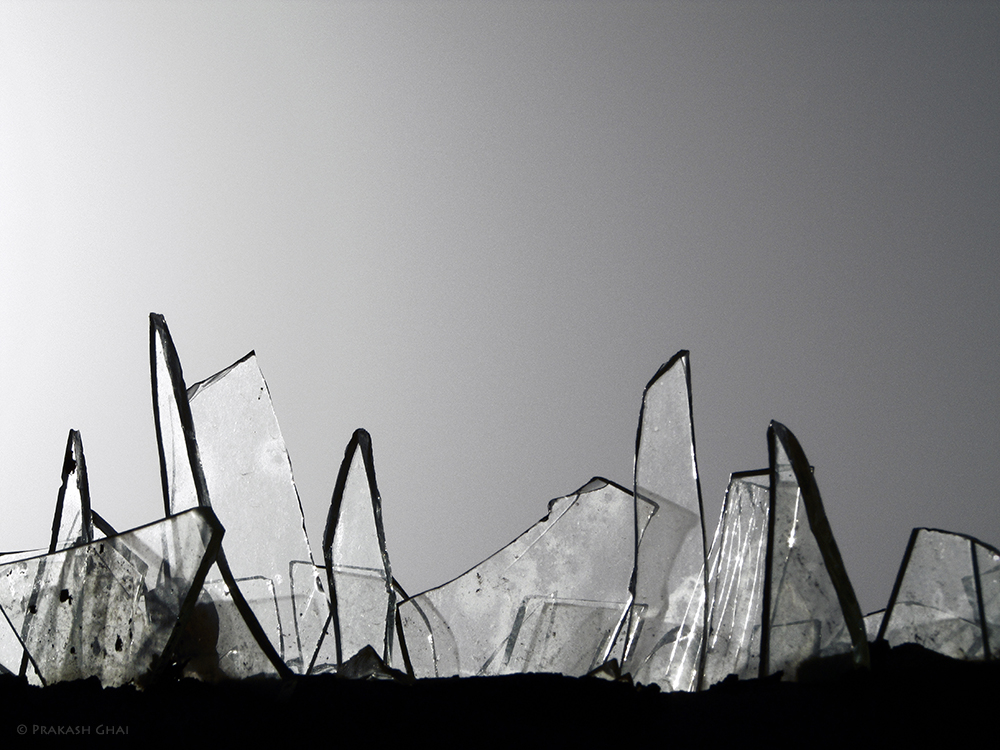
Minimalist Photography Example 1:
 |
Minimalist Photography by © Prakash Ghai Sold to ex-Sotheby's curator: View NFT |
As you see above, the subject "pieces of broken glass on a boundary wall" is placed in the bottom third of the frame, following the rule of thirds, while the rest two-thirds of the frame (top) is left empty and is filled with negative space.
Negative space here is used to make the eyes lead to the subject and give it amplified attention.
Also circling back to my earlier point, there is "Tremendous Visual Clarity" here. There are no distractions or other disturbing elements. All have been taken out with appropriate lens zoom and my physical movement and positioning ensuring appropriate decluttering.
Also circling back to my earlier point, there is "Tremendous Visual Clarity" here. There are no distractions or other disturbing elements. All have been taken out with appropriate lens zoom and my physical movement and positioning ensuring appropriate decluttering.
The elements are minimal: only the glass and the sky. The color palette is also minimal and the photograph is fairly easy on the eyes and to comprehend.
OK, Let me take one more example of a Minimalist Photograph:
Minimalist Photography Example 2:
I captured this shot at Jawahar Kala Kendra in March 2026. I have used simple geometry as the core minimalist photography type here. The simple geometric shapes mainly being lines.
Some lines run along the right side, and one runs on the bottom left of the frame, that acts as a leading line or an entry point into the frame. I had underexposed the photograph to not lose any details in the highlights
You can see a lot of negative space on the left and some in the lower part of the frame, which helped me strip the frame down to its essential elements that I wanted the viewer to focus on.
The color palette is also minimal. Yet, the photo pops. This is exactly what needs to be accomplished in minimalist photography. Making everyday objects pop using the rules of minimalist photography in simple yet creative ways.
 |
Echoes of the unsaid - Minimalist Photography by © Prakash Ghai 2026 |
Minimalist Photography Camera Gear
A lot of people ask me as to what Camera Gear I use to capture Minimalist Photos and what Camera Gear they should use for it.
To be honest, you do not need a Special Camera Gear, your regular Camera Kit or even your Phone Camera is enough to capture Minimalist Photographs.
Sure, one thing you do need is the Eye to See and see things in a different manner.
Anyways, I currently use a Canon 6D Mark II Full frame Camera and 50 mm prime and 100 mm prime lens and 24-105 kit lens to capture most of my Minimalist Photographs. Recently I have also started using my iPhone for some shots.
To view the complete list of all the equipment I use, click here: Camera Gear
Minimalist Photography Camera Settings
Now about Camera settings, I would give you a brief idea, but again it depends on your shooting style as well what settings you are comfortable with and it also depends on the subject and scene you are capturing.
Aperture:
f/1.8–f/2.8 for subject isolation. f/8–f/11 for sharp geometric scenes and if you are shooting multilayer then you can also opt for f/22. I used that a lot actually.ISO:
Keep at 100–200 for clean noise-free images most of the times but if you are dialing down hard like me and have a full frame camera then yeah you can go as high as 4000, why not. Sometimes a bit of grains look good especially when you are shooting black and white or showcasing geometry.Shutter Speed:
1/250s or faster for static scenes; 30s–120s for long-exposure. I personally don't do long exposure minimalism.White Balance:
Set manually always to avoid inconsistent tones. Some cameras perform well on Auto as well, mine doesn't that much. I am currently using a Canon 6D Mark II.Shoot in RAW:
Shooting in raw gives maximum control in post-processing. It really comes in handy when you are shooting light and shadow minimalism. The part with most light or sunlight loses detail in JPEGs, RAW file helps you bring the detail back in those areas.Tripod:
Essential for long exposures and for ensuring precise, deliberate composition. It also slows you down, which in minimalist photography is exactly the point. |
Minimalist Photography by © Prakash Ghai View NFT |
Some quick Minimalist photography FAQs
Q. Is minimalist photography only done in black and white?
A. No, color is as valid. Black & white is only an individual preference.
A. No, color is as valid. Black & white is only an individual preference.
Q. Do I need an expensive camera for minimalist photography?
A. No. Your phone is also enough. Minimalism is not about what gear you use. It's purely vision.
Q. What subjects work best for minimalist photography?
A. Architecture, shadows, geometry, and isolated subjects work best as these subjects have strong visual structure.
Q. How much editing is needed in minimalist photography?
A. Minimal. If you need heavy editing to make it work then the shot wasn't ready.
Q. Can I do minimalist photography indoors?
A. Yes, indoors is fine too. A single object against a plain wall is all you need to start.
Q. How do I know when to stop removing elements from a frame?
A. When removing one more thing breaks the meaning of the entire frame, stop there.
Q. How is minimalist photography different from abstract photography?
A. Minimalism simplifies reality. The subject is still recognizable. In Abstract photography it may not be. They overlap sometimes, especially in Zeroism.
Q. Do I need to crop a lot to get the frame right?
A. No, nothing as such, you may or may not crop to arrive at a clean minimalist frame. I recommend taking the final shot on the spot.
Minimalist Photography for Beginners: 6 Simple Steps
If you’re new to Minimalist Photography and want to start shooting right away, here are 6 simple steps you can follow:
 |
| Minimalist Photography by © Prakash Ghai Buy a Print |
1. Choose one main subject
Pick a single object, shape, or structure as the main character of the frame.
2. Remove distractions
Move around, change your angle, or wait until people, vehicles, and messy backgrounds are gone.
3. Use negative space intentionally
Place your subject off‑center and leave lots of empty space so the eye naturally pulls toward it.
4. Look for geometry and lines
Capture walls, windows, railings, roads, or shadows that create simple shapes or leading lines. Repetition work also works well sometimes.
5. Simplify color and tone
Avoid too many bright colors or textures. A simpler color palette often makes the image feel more minimal.
6. Shoot with intention, not luck
Think before pressing the shutter button. Each element in the frame should be there for a reason. If removing one thing breaks the meaning or the photograph, that is where you need to stop.
If you practice this way for a few weeks, you’ll start seeing the world in simpler, cleaner forms.
Minimalist Photography for Advanced Shooters
At this level you are not following steps anymore. You are making decisions. The difference between a beginner and an advanced minimalist photographer is the ability to see what does not belong in a frame before you even raise the camera.
Every element you include is a choice, and every element you leave out is an equally deliberate one.
There are 8 distinct types of minimalism in photography and understanding each one is what sharpens that instinct.
I have broken all of them down here: Types of Minimalism in Minimalist Photography.
You can also take a look at my Portfolio where I have used the types of minimalism described above in creative ways.
 |
| Minimalist Photography by © Prakash Ghai |
Concluding thoughts on Minimalist Photography
Minimalist photography isn’t about creating empty images. It’s about making intentional ones. Every element that appears in the frame is there for a reason. The idea is straightforward. Remove anything that doesn’t add to the photograph, and allow the remaining elements to stand out and communicate clearly.
Is Minimalist Photography Growing in Popularity?
Something interesting happened around 2025. Google Trends data shows that worldwide searches for “minimalist photography” were virtually zero from 2004 all the way through to 2024. Then it suddenly exploded.
The term went from nearly being invisible to peak search interest within months. What makes this more striking is the comparison. “Minimalism” as a term has been searched consistently since 2004. It peaked around 2016 to 2017, the Marie Kondo era, the tiny house movement, all of that. It never went away.
But “minimalist photography” as a specific search stayed flat at near zero through all of that. People were interested in minimalism as a lifestyle and aesthetic for two decades. They just were not yet connecting it to photography as an art form or a practice they could learn.
That connection is being made now and the data shows it happening almost vertically. I find this fascinating because I started shooting and writing about minimalist photography in 2012, and built a community around it from 2015.
For over a decade, the practice existed and the community grew quietly. The search demand simply was not there yet. Now it is. If you are reading this and just discovering minimalist photography for the first time, you are arriving exactly at the right moment. The aesthetic has been developing for years and is only now entering mainstream awareness worldwide.

You’ve just experienced the power of less. Now live with it. Explore the Minimalist Photography print collection:
If this article helped you see differently, buy me a coffee. It keeps me writing.
Minimalist Photographs are "Simple" to look at but very difficult to make. You need to change your perspective. To train your eyes and start seeing subjects in term of shapes, please read Train your Eyes for Minimalist Photography article.
Now you can enroll for Online Classes on Minimalist Photography
Tap: Online Classes or send a DM on Instagram
Experience Minimalist Photography in Person at Jawahar Kala Kendra, Jaipur
 |
| Minimalist Photography by © Prakash Ghai Jawahar Kala Kendra, Jaipur: View NFT |
If you are in Jaipur and want to experience minimalist photography in person, I run a guided photowalk at Jawahar Kala Kendra. We spend two hours together in total.
One hour learning minimalist photography theory via a visual presentation, followed by an hour of photowalk shooting geometry, light, and shadow together at one of the most architecturally rich locations in Jaipur. I have been shooting there for over a decade.
You can book a spot directly on Airbnb App under the Experiences tab in Jaipur.
Among photography experiences in Jaipur, this is one of the rare ones that covers both the thinking and the doing in a single two hour session.
Phone or DSLR, beginner or intermediate, the walk is built around training your eye to see geometry, light, and shadow the minimalist way.
Groups are capped at 4 so the entire session stays focused on you. Dates go quickly. Lock your spot before it fills.
Prakash Ghai
45 comments:
Bravo
Thank You Tartiplume Dans.
Have a Nice Day. I send you Greetings from Jaipur - the Pink City of India.
I love your photos. You`ve definitely got an eye for details and minimalistic compositions!
Thank you. I wish you a great day.
I absolutely love your photos, I love your sense of shape and color. I am a High school student in america and I'm doing a project for a photography class where I take a photographer and emulate their style. I was wondering if I could use your photos? I really enjoy your photos and I find myself taking very similar pictures. Also is there anywhere I could find out more about you as a photographer?
Hello There, Thank you for your interest in my work. Yes, you could use my photos/blog notes to share it with co-students/friends. I am also on Instagram https://www.instagram.com/prakashghai/ and on Facebook https://www.facebook.com/prakash.ghai
https://www.instagram.com/piggi33/
Some minimalistic, some other https://www.instagram.com/jj_laaksonen/
Hello Prakash, I'm very impressed with your work and your way of seeing things minimal. I follow you on Instagram and saw the article "What is Minimalist Photography?"
I would be happy if you and some of your follower visit my IG account at: https://www.instagram.com/contratempo_photodesign/ to see a few of my minimalistic photographs.
Warm Regards, Paulo.
Hello Prakash,
Love your work and seeing other talents in the LearnMinimalism feed on Instagram.
On my IG account, I explore minimalism and also texture, shadow and color.
https://www.instagram.com/jean__morin/
Thank you Pier for your link submission.
Thank you Jari Laaksonen for your link submission.
I particularly liked that black and white minimalist bicycle shot on your Instagram Timeline.
Hello Paulo, Just went through your Instagram Timeline. Your profile is really interesting. Some of your minimalist photos are extremely extremely good. Well done.
Hello Jean. Thank you for taking time out for this.
Your Minimalism work is "Phenomenal"
Such great vision.
Well done. My compliments.
I've been following your "learnminimalism" project for a long time, and it's always a pleasure to discover your work.
https://www.instagram.com/kiks_way/ :-)
Thank you, and I too have been following rsa_minimal from a long time. Nice community. Thank you for following the "LearnMinimalism Instagram Community" and using our hashtag #LearnMinimalism
Big fan of learnminimalism, keep it up! I do minimalistic stuff using only the camera of my phone :
https://www.instagram.com/attentaatti
Thank you for writing in and following our Instagram page https://www.instagram.com/learnminimalism
Had a look at your work. Very Interesting.
Good luck with the selections.
I have always loved your work and your dedication towards it. Keep up the brilliant work, sir :)
-prachi
https://www.instagram.com/p/BG01f2QA5Up/
Thank you Prachi. :)
Thank you Prachi. :)
I'm a big fan. Keep it up the good stuff!
https://www.instagram.com/jazmatialaa/
Thank you for writing in. Your work is brilliant.
Big fan of minimalism photography & page Learnminimalism !
Greetings from Lithuania !
https://www.instagram.com/andrius.blyksnis/
Thank you for writing in.
I'm just a beginner in this category and thanks to Prakash I learned a lot from him and his website.. :)
My account- www.instagram.com/veesv_minimalism
Welcome.
Happy Clicking.
Welcome.
Happy Clicking.
https://www.instagram.com/ruby83/
Thank you for writing in.
Thanks for creating awareness about minimalism. May be now I will also give it a try
Welcome. :)
Hi Prakash, I love your work and your articles. I moderate on the Martin Leach Minimalism Contest and Minimal Photo and Art communities on G+. My greatest love is B/W minimalism. I'm considering starting my own B/W Minimalst community on G + and was wondering if it would be ok to name the categories, based on your article, Types of Minimalism. Thanks in advance Keith
Hello There- Send a message on Google+ or Facebook
Need more clarity
Prakash, I suggest that you highlight this post by placing it on the top of the side menu. I was trying to search what minimalist photography means and had to spend some time locating this post. It would help the new visitors to your blog if a link is given at a prominent position.
Thank you for the feedback :)
I love photography, every aspect of it. Didn't know about Minimalist, until now.
Your explanation is wonderful. I've learned so much from this, it's amazing.
Thank you!
Welcome :)
I've never heard of minimalist photography but I love the concept of it and there is no arguing the beauty and depth of your photos!
Thank You :)
Nice Work
Thank You
I couldn't have said it better. It's well explained, with example, links to a video, article etc...... Brilliant work Prakash. Now I'm waiting for your first book with minimalism as theme.
I have always loved your work and your dedication towards it. Keep up the brilliant work :)
Let me know your reviews about mine too :
https://www.instagram.com/visualsbysamyak/
thank you
Post a Comment