Minimalist Photography Definition
Last Updated: March 2026 Minimalist Photography is basically photography done using as few elements as possible within a frame and leaving out clutter or that which is not required.
This, in turn gives the subject amplified attention and helps in creating clean, less busy and visually soothing to look at Minimalist Photographs.
Where does Minimalist Photography take it's inspiration from?
Minimalist Photography takes it's inspiration directly from Minimalism.
I am not going to make you deep-dive into the History of Minimalism but here is how it started in short.
Minimalism that literally means "Minimum" or Reduced to bare essentials, started as a Reductive Art Movement in the 1950s in the United States led by Minimalist Painter "Frank Stella", who once famously said about his paintings "What you see is what you see."
Minimalism anchors Simplicity at its core and it is based on the principle: "That which is less complicated is better understood."
In Minimalist Photography, we follow this core Philosophy.
What are the core hallmarks of a Minimalist Photograph?
We must Keep in mind, that a minimalist photograph must ensure four things:
- Tremendous visual clarity
- Enhanced or amplified attention to the core subject
- Non-complex to look at on first glance
- Photograph should not create a sense of confusion in the mind of the viewer.
What are the key elements of a Minimalist Photograph?
- Lines
- Shapes
- Patterns
- Symmetry
- Geometry
- Isolated Subjects
- Strong Colors
- Sharp Color Contrasts
- Negative Space
- Repetition
One can use one or more of the elements in the same photograph. The most used element is generally negative space along with the general rule of photography that is rule of thirds.
Other than that it is up to the photographer as to how he or she wants to proceed in composing minimalist photographs using a permutation combination of elements as per taste.
Minimalist Photography Formula?
Minimalist Photography = Minimalism + Visual Art
Minimalism (less is more) + Visual Art (the craft of composing a visually compelling image within a frame).
I don't mean the visual arts stream here by visual art. Just doing literal meaning for ELI5(explain like I'm 5 years old)
That formula is simple enough to remember I hope.
OK, enough of theory, now, let's take an example of a Minimalist Photograph that I took, with the use of some basic Minimalist Photography principles and Negative Space.
Minimalist Photography Example 1:
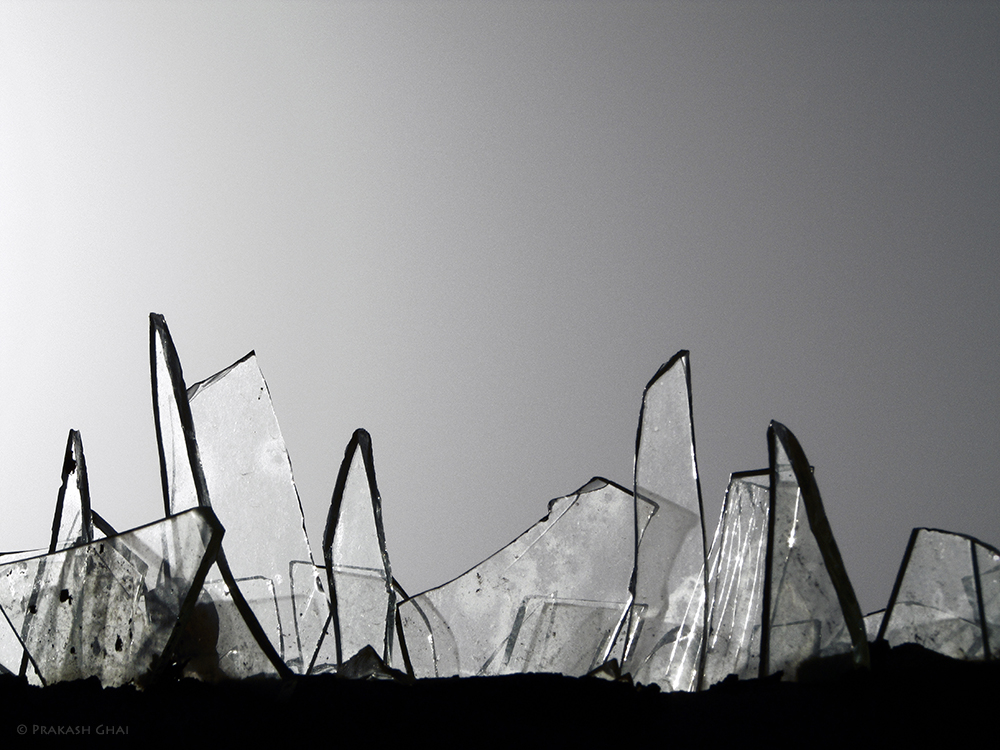
If you see above, the subject Pieces of Broken Glass on a boundary wall is placed in the bottom 1/3rd of the frame, while 2/3rd of the frame (top) is left empty.
That empty space is Negative Space and it is used primarily to make the eyes lead to the subject give it amplified attention.
Also circling back to my earlier point there is "Tremendous Visual Clarity" here.
OK, Let me take one more example of a Minimalist Photograph:
Minimalist Photography Example 2:
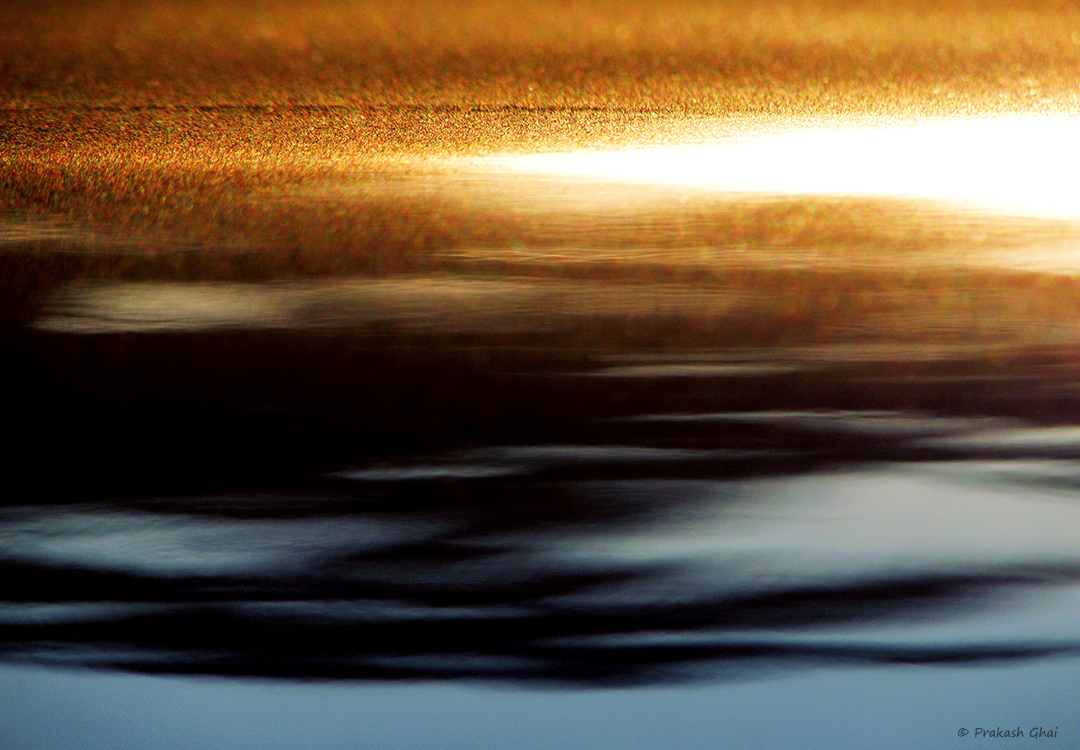
I captured this shot at Jawahar Kala Kendra in March 2026. I have used simple geometry as my core subject here ie Lines, and used the shadow area and single color underexposed to amplify attention and focus on the subject.
 |
| "Echoes of the unsaid" © Prakash Ghai 2026 |
What is the subject? The area in the light patch with geometry within the exterior lines of the patch. Note that I have stripped out all clutter for easy comprehension of the photograph at first glance.
Minimalist Photography Camera Gear
A lot of people ask me as to what Camera Gear I use to capture Minimalist Photos and what Camera Gear they should use for it.
To be honest, you do not need a Special Camera Gear, your regular Camera Kit or even your Phone Camera is enough to capture Minimalist Photographs.
Sure, one thing you do need is the Eye to See and see things in a different manner.
Anyways, I currently use a Canon 6D Mark II Full frame Camera and 50 mm prime and 100 mm prime lens and 24-105 kit lens to capture most of my Minimalist Photographs. Recently I have also started using my iPhone for some shots.
To view the complete list of all the equipment I use, click here: Camera Gear Minimalist Photography Camera Settings
Now about Camera settings, I would give you a brief idea, but again it depends on your shooting style as well what settings you are comfortable with and it also depends on the subject and scene you are capturing.
Aperture:
f/1.8–f/2.8 for subject isolation. f/8–f/11 for sharp geometric scenes and if you are shooting multilayer then you can also opt for f/22. I used that a lot actually.
ISO:
Keep at 100–200 for clean noise-free images most of the times but if you are dialing down hard like me and have a full frame camera then yeah you can go as high as 4000, why not. Sometimes a bit of grains look good especially when you are shooting black and white or showcasing geometry.
Shutter Speed:
1/250s or faster for static scenes; 30s–120s for long-exposure. I personally don't do long exposure minimalism.
White Balance:
Set manually always to avoid inconsistent tones. Some cameras perform well on Auto as well, mine doesn't that much.
Shoot in RAW:
Shooting is raw gives maximum control in post-processing. It really comes in handy when you are shooting light and shadow minimalism. The part with most light or sunlight loses detail in JPEGs, RAW file helps you bring the detail back in those areas.
Tripod:
Essential for long exposures and for ensuring precise, deliberate composition. I never used one honestly.
Some quick Minimalist photography FAQ's
Q. Is minimalist photography only done in black and white?
A. No, color is as valid. Black & white is only an individual preference.
Q. Do I need an expensive camera for minimalist photography?
A. No. Your phone is also enough. Minimalism is not about what gear you use. It's purely vision.
Q. What subjects work best for minimalist photography?
A. Architecture, shadows, geometry, lone objects.
Q. How much editing is needed in minimalist photography?
A. Minimal. If you need heavy editing to make it work then the shot wasn't ready.
Q. Can I do minimalist photography indoors?
A. Yes, indoors is fine too. A single object against a plain wall is all you need to start.
Q. How do I know when to stop removing elements from a frame?
A. When removing one more thing breaks the meaning of the entire frame, stop there.
Q. How is minimalist photography different from abstract photography?
A. Minimalism simplifies reality. The subject is still recognizable. In Abstract photography it may not be. They overlap sometimes, especially in Zeroism.
Q. Do I need to crop a lot to get the frame right?
A. No, nothing as such, you may or may not crop to arrive at a clean minimalist frame. I recommend taking the final shot on the spot.
To Conclude:
Minimalist photography isn’t about creating empty images. It’s about making intentional ones. Every element that appears in the frame is there for a reason. The idea is straightforward. Remove anything that doesn’t add to the photograph, and allow the remaining elements to stand out and communicate clearly.
I also have a Visual Representation of some of my Minimalist Photographs in the form of a Slideshow that I have posted on my YouTube Channel. Click here to view --> Minimalist Video
Minimalist Photographs are "Simple" to look at but very difficult to make. You need to change your perspective. To train your eyes and start seeing subjects in term of shapes, please read Train your Eyes for Minimalist Photography article.
It is also possible that Minimalist Photography as a genre is not meant for you, as you are currently in a very different phase of life than me or other Minimalist Photographers.
Find out which Phase of Life you are currently in, that could also help you find the best suited Photography Genre for you.
Now you can also enroll for Online Classes on Minimalist Photography via Zoom or Google Meet.
Tap here: Online Classes to connect or send me DM on Instagram if you want to personally meet in Jaipur for a 1-1 workshop